Wednesday, 29 April 2015

A trip to Tai O, Lantau Island


(Sunday, 24 April)
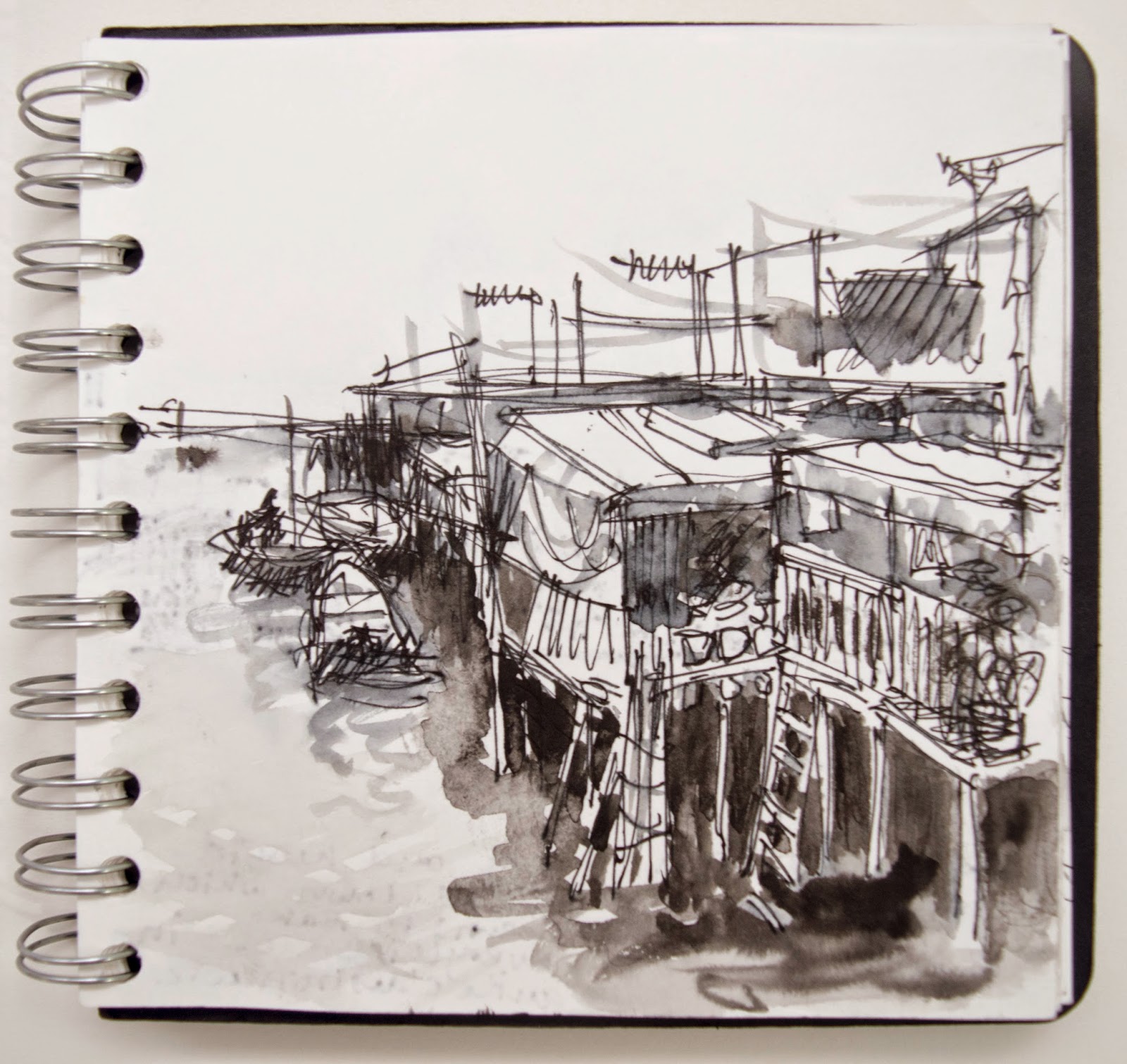
Tai O - Stilt dwellings still inhabited by the local Tanka boat people
Okay, lets start with a tourist guide synopsis - Tai O is a small village on the far western side of a large, verdant and mountainous island to the north-west of Hong Kong, called Lantau. It’s the historical location of the Tanka boat people, fisher-folk who live in stilted houses that stand on the shallow waters of the bay, and who still make their living drying fish on hooks from the front of their modest dwellings or on traditional straw mats. It’s on these mats that their famous shrimp paste is also sun-dried.

I make the trip with Mian - it’s her only day off and she wants to do something away from the frantic bustle of HK life. I could do with getting out of the city too! 
We take the ferry from pier 6 in Central; it’s a pleasant forty minute trip which takes in great views of HK harbour and its familiar skyline as it gradually retreats into the smog haze. This is also one of the busiest shipping lanes, and the views are interrupted by the to and fro of countless freighters and cargo vessels, sometimes less than a few hundred feet away.
Once we reach Lantau’s ferry pier, Tai O is reached by a half hour bus ride past some fabulous and mainly deserted beaches (where are my swimming trunks?).

Shrimp paste drying in the sun.
Today is Sunday so the small coastal village is crowded with sight-seers who are packed close to the bus drop off point - no MTR station here…yet. But walk several hundred yards and you’re pretty much on your own in a labyrinthine network of stilted walkways and makeshift floating dwellings, boats and mats of drying fish. There’s also the shrimp paste! The mats look very photogenic with their delicately coloured pink shrimp carpet - but the smell; it’s pungent and overpowering! The nearby batteries of blue vats house fermenting gallons of shrimp, which will in turn be dried, so you might be able to begin to imagine how rank the odour is. Mian says it’s too much for her and she will wait for me up the path while I get some photos. Some people are just light-weights I guess…

We go on a “dolphin” cruise, ostensibly to catch a glimpse of the Pearl River estuary ‘white’ dolphins (so say the posters and tourist guides), which are in fact bubble-gum pink. Well I’d love to see a pink dolphin as much as the next tourist, but sadly their numbers have declined to such an extent (due to untreated sewage, boat pollution and net fishing) that such sightings are rare these days. I’m afraid that the kids on the boat are going to be disappointed. Mian explains to me that the boatman is saying to them “don’t even blink, or you’ll miss them”. Flying pigs will also wing their way past the boat any second (thus speaks the age hardened cynic!). 

What you do see as you round the headland is the huge and all too real expansion, taking place to the north - the continuing airport development. Tai O looks very fragile indeed in the face of this.

It is nonetheless a great place to draw, and perhaps its attraction is, like so much of what I’ve been attracted to in HK, a bittersweet thing. Whether it can survive the juggernaut of expansion is debatable. Last time I was in HK there was no MTR link to Lantau. Now it is no longer an island. The MTR now extends by bridge to Tung Chong where a cable car ride will take you to one of the largest statues of Buddha in the world - a journey previously only possible by ferry and bus. Lantau is also home to the HK international Airport and a Disneyworld theme park, all connected by the MTR. It’s an easily commutable journey to Central HK, and those who can afford it want to live here, away from the noise and claustrophobia of the intense urban existence there; and the high-rises are going up, oh how they are going up. 

It’s probably safe to say that the extreme west of the island is safe from building development, but its not safe from being just something to be consumed by the visitors, captured on their cell phones and shared on social media - and then forgotten. And it won’t be long before some entrepreneurial son of a Tanka fisherman figures out that its easier to set up a factory in China to dry and bottle shrimp paste than it is to spread it out onto straw mats in the sun.

A Visit to The Island School


Morning, 25 April

The Island School - from school website. What a view!
I visited the Island School with Mian Ng (UWE international student co-ordinator), to meet with Helen Palmer Head of the Art Department, and discuss delivery of a one day drawing and sketching course with  a group of twenty one 14-15 year old art students. The school boasts probably one of the best views in the world, located as it is between Kennedy Rd and The Peak, see the above photo from their website. Students at the school sit examinations offered by the UK Examination Boards and the International Baccalaureate Organisation, so there’s no problem with speaking English, and all the sudents I met, English, American and Chinese, spoke perfect English.
Although I’m going to be working with a group of 14/15 year olds, we visit a group of school leavers as Mian is there to deliver a presentation about the University of West of England, and the arts and media courses that some of the students might like to study in England. Mian is a passionate advocate for UWE, but it also gives me the opportunity to sell the print-making department and tell the students how they can use the in-house technical skills and processes to support their chosen fields of study. Someone asked Mian “what should we do in the holidays if we are thinking of pursuing an Arts degree?"; I said “keep a sketchbook!”
A number of them seemed very interested in UWE (particularly in fashion), so maybe they will be persuaded to enrol for an undergraduate course there… I hope so.

I agreed with the Head of Art that we would take the students out to the Hong Kong Park. As it’s such a big group I’m hoping to enlist the support of some UWE international students who have finished studying in HK and expressed an interest in helping. This will mean that I can split the group up into smaller ones of 5/5+1; that way they can receive more individual support (if they need it). I really enjoyed the visit to the school, Helen is a very friendly and enthusiastic Department Head (and so are the other members of staff I met), and I look forward to taking the students out to draw.

Friday, 24 April 2015

Sham Shui Po - Government Public Housing


View of Sham Shui Po from HKOP studio - Impression from tiled photographs

This view of Sham Shi Po and Shep Kip Mei beyond is the view I have from my working space at the HKOP, and shows the impact that the public housing program has on the environment in HK. The sheer scale of these high rises is overwhelming - and impossible to convey in my drawings here. The start of this huge and ambitious public housing scheme was driven by the need to urgently re-house some 53,000 people after a fire broke out in the shanty town that existed right here in 1953; this prompted the then Colonial Governor to commence a program of high density housing as a solution to the problem which continues to this day. Poor housing and urban decay are one of the biggest problems facing the HK administration (there was an article today about residential housing shortfalls on the front page of the South China Morning Post). 
 
Le Corbusier - Concept for "the contemporary city" 1925
This “mega-structuralist” approach is reminiscent of the architect Le Corbusier’s concept for “the contemporary city” which he formulated back in 1925 as a radical new approach to urban planning (I’ve included one of his impressions to show the similarity between his concept drawings and the view from the studio). In the UK such schemes have proved highly unpopular, and many of the high rises that were built in the 1960’s have since been demolished.

To my western way of thinking, these buildings seem abhorrent - I am unable to get my head round the idea of living in them, and find it hard to walk the short distance from the MTR station to the print studio without my gaze turned upward in wonderment - and horror. These buildings are 40 storeys high! I feel more than slightly queasy when I look at the ground from the 8 floors up that the print studio is.

Machines for living in - High rise close-up
Maybe it will come as a surprise then that HK residents love them, and that those who do not yet live in such buildings aspire to do so. But HKers are ever pragmatic people, and this radical high density housing is a necessary solution where the population density is so great, and what land there is must be exploited to its fullest potential. It's a practical solution to a problem that isn't going to disappear, so why complain (seems to be how they see it).

What such housing does provide (and which was a fundamental part of Le Corbusier’s concept) is far more cost effective service provision for such a high population density.There are
beautifully maintained shared spaces here and access to one of the most efficient transportation systems in the world, as well as to the shops and street cafés which are such an important part of HK life.

Sketch of view from HKOP - It's 8 storeys up so the perspective is quite strange!

Sunday, 19 April 2015

A Visit to Hong Kong Island and The Peak


A Visit to Hong Kong Island and The Peak

(Saturday 18 April, late morning, and afternoon)
View from The Peak
If the weather is going to change then a visit to The Peak is in order. Along with the view from Kowloon, the guidebooks rate this as a “must see” experience, and it’s easy to see why. Victoria Peak is 552 metres high, and the much photographed view is spectacular, with views of the island skyscrapers below, the harbour across to Kowloon City and beyond into the New Territories and China on a clear day.
I’ve got a rucksack of drawing books, brushes and my camera. There’s no way I’m walking up there as it’s a pretty steep climb without all this stuff, so I’ll be a proper tourist and go on the Peak Tram, a real piece of colonial history. I am stunned by the view skywards as I emerge from the Central MTR station. It’s the sheer scale of the immensely tall buildings crammed together into this space. I can’t help but walk along with my eyes craned upwards, an incredible vision, and it makes me feel very small and solitary indeed. The space in Kowloon seems airy and open in comparison. I make my way to the Peak Tram Lower terminus. If I thought I was just going to hop on, I’m very much mistaken - the place is heaving (and I mean heaving) with tourists, slowly snaking their way along a zigzagging path towards the ticket kiosk, and then there’s a wait for the tram itself, an estimated 45 minutes; I may well lose the will to live by then, but there’s no choice, so I endure the heat, humidity and noise until it’s my turn to board and make the journey up to the Peak Viewing Station. At the top you disgorge into an air-conditioned viewing station with shops, eateries and souvenir outlets. I need a cup of coffee so I stop for one in a coffee shop that must boast one of the best backdrops in the world (shame it sells the worst coffee!). 

Japanese tourists with "selfie" stick
Drawing here, near the viewing station is almost impossible. People here look over your shoulder constantly which I can live with, but I do mean literally about 6 inches from your ear, for what seems like an age. I don’t think the Cantonese see invading your body space as an issue! I decide to take a walk - there are lots of old railed promenades through the lush and dense tropical forestation of the upper slopes, so actually it’s fairly easy to get away from the crowds and find some space…
The weather is overcast so the view isn’t as good as it might be, with the iconic towers of the Bank of China, and the Central Plaza swirling in and out of view like huge ghostly apparitions. I can’t see the top of the International Commerce Centre, Hong Kong’s tallest building as it’s upper storeys are (today) permanently enshrouded in the cloud ceiling. It all looks rather beautiful and mysterious though, the reduced visibility creating a strange kind of almost claustrophobic closeness that you wouldn’t get on a clear day.
Eventually I return to the throng at the viewing tower - glad I didn’t pay for a ticket to go up to the upper viewing platform as it would have been a complete waste of money. There are enormous queues of people waiting to make the return journey, so I decide to go back on foot - at least I’ll be lugging my kit down, rather than up!
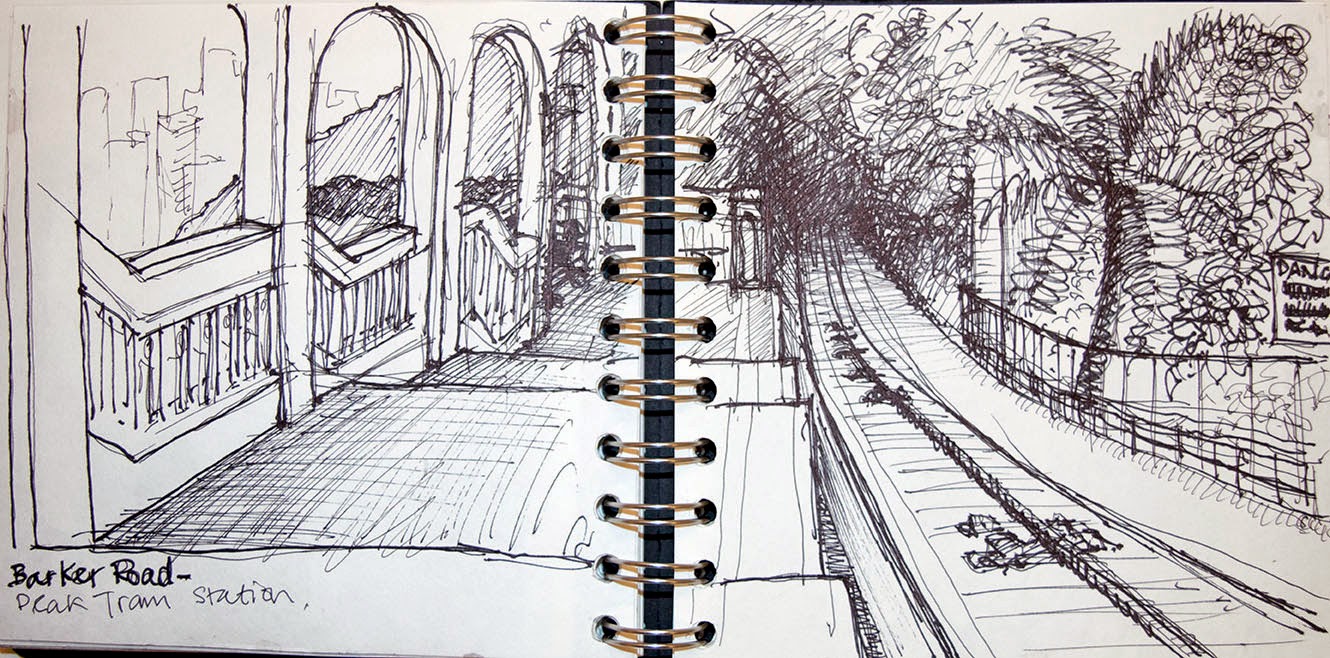
Barker Road Station - no crowds here! Great view while you're waiting for a tram
And I’m glad I did - if you want to beat the crowds this is the way to make your way back down into town, the views are great and you go along some beautiful old parkways and walks. I can hear the tram rumbling down the slope somewhere overhead and I follow the sound, emerging onto an old station platform some 120 metres below the upper terminus, and with only a handful of people around - a perfect place to draw. Whilst I’m there 3 or 4 workmen turn up and stand around smoking, talking loudly and laughing amicably. I wonder what they are doing there and then when the next tram is descending one of them puts out his arm and hails it, like a taxi! They all get on… and I decide to as well - we have to stand but I don’t care, it beats the queue up at the top, and the view from just behind the driver’s head is far better than on the way up - there are heart in mouth sections of track that we negotiate on our way back down to the lower terminus. 
Walking is definitely the best way to see this city - you can take the MTR to get you to central, or the starting point of your excursion, but most of what you want to see is accessible on foot if you don’t mind putting in some legwork.

Friday, 17 April 2015

Hong Kong Island from Tsim Sha Tsui


The amazing weather we’ve been enjoying here for the last week is not going to last, so I thought I’d take the opportunity to make a sight-seeing trip. Tsim Sha Tsui is only a few stops down the MTR line from Shim Shi Po, where the HKOP is located, and it’s from here that some of the best views of Hong Kong Island can be seen. Yung suggested getting there for about 6pm - that way you can watch the business district sky-scrapers of Wan Chai and Central take on their mantle of flashing coloured neon as night descends.
The Star Ferry concourse is a good location to take in the view across the harbour and its to there I head… the view is incredible, the buildings crammed onto the lower levels of HK Island and reflected in the water of Victoria Harbour make this one of the iconic vistas of the modern world. The Star Ferry, a relic from HK’s former colonial history still makes its way across the harbour to Central. And on a warm clear evening with the sun shining, its right for capturing that perfect shot.
And the sight see-ers are out in force, from serious photographers with their tripods, telephoto lenses and expensive DSLRs to the smart phone snappers with their selfie sticks. There is a massive industry focussed here capitalising on the view, together with swanky shore front hotels and restaurants; famous brands such as Tiffany’s, Cartier, Louis Vuitton, all have outlets here, all catering for the huge passing trade. Very expensive motorboats make their way around the harbour. More than anything this is a place to be seen.
There are photography stalls where you can have your picture taken against this famous backdrop, all displaying examples of their craft - people doing handstands, contorted into yoga asanas, young lovers, family groups. The one thing that all these subjects share is this view.
Its one of my less memorable experiences so far. Everyone here is so self obsessed and no-one is that interested in what they are looking at. The view has become a commodity and its consumption devalues it as authentic experience - IMHO. 
One of my favourite moments is when a huge freighter carrying several hundred tons of gravel is impertinent enough to chug slowly across the harbour, 'spoiling' the backdrop for a good ten minutes or so and giving rise to various expressions of frustration and mild annoyance!

The HKOP Studio


The HKOP Studio is on the Top floor of the JCCAC with stunning open views over the district of Sham Shi Po. I’m warmly welcomed by Yung and Ho Yin, two of the HKOP directors, and we go to lunch at a local Dim Sum restaurant together with Louiza (who was the exchange student over at UWE last summer), Ranee and Alvin, who also work at HKOP, and Rainbow, an artist who is making a lithographic print at the studio. The print-shop has very recently moved into this new and more spacious studio space, so there’s still lots to do to get everything properly up and running. But its already possible to do lithography, small etchings, and screen-print will be possible once some screens have been made up (which should be by the end of the week). 

The Heidelberg Press at HKOP
AB Dick 350 Litho Press Instruction Manual
Instruction Manual - love the graphic!
There is a library of Chinese type for letterpress, a Heidelberg press and an AB Dick 350 offset press, both of which need to be refurbished and set up for use. There used to be a thriving printing industry in HK which has gone into decline since the opening up to mainland China, after which it could no longer remain competitive. The presses have been donated by local companies that have ceased to trade. Ho Yin says the problem with setting the machines up will be finding technicians who are still living to do the job!  
I’ve included some photographs and drawings to show the studio and some of the machines and equipment, including the litho press in use. It will be amazing when everything is up and running, a light and spacious environment in which to work.

Rainbow Leung and Ranee Ng Sio-Leng in the studio
Japanese Lithography Press
Litho Plate by Rainbow Lueng

My first visit to Sham Shi Po, JCCAC and HKOP


JCCAC logo
Hong Kong Open Print Studio is situated on the 8th (top floor) of the JCCAC (Jockey Club Creative Arts Centre) in Sham Shi Po, a laid back district of Kowloon with a mixture of residential high rises, shops, and busy street-markets. This former factory building now houses the JCCAC, where more than 100 artists and art organisations are based across a wide cross-section of the creative and visual arts: painting, sculpture, calligraphy, ceramics, glass art, printmaking, installation, photography, animation, video production, music, dance and drama, are all represented. So all in all its a groovy and happening place within a vibrant residential community, with lots going on.
 
JCCAC building from street
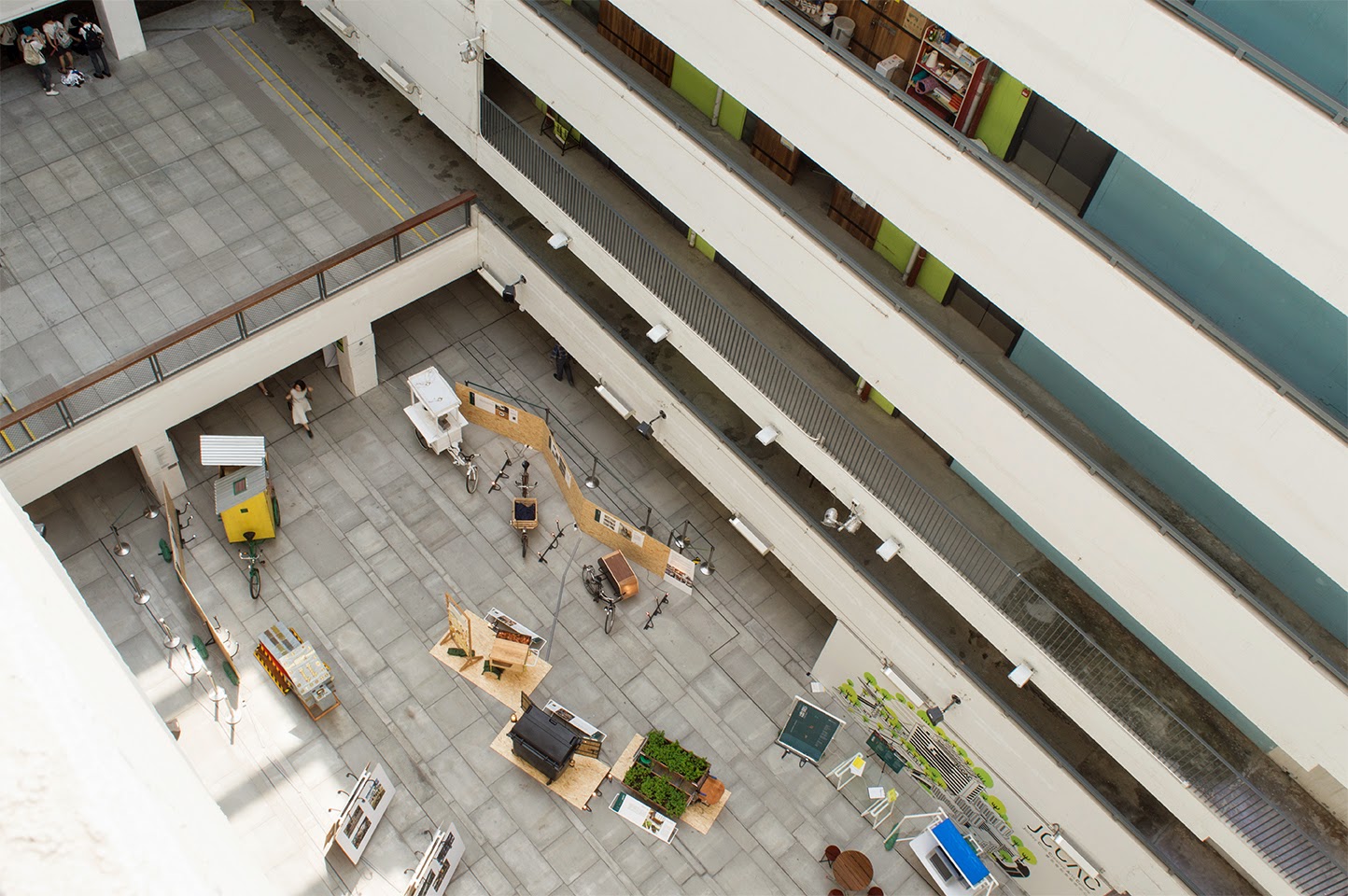
The building has been restored with funding from government grant. It has maintained its original open structure (no glass), which allows the central courtyard to be viewed from every level. The glass cover at rooftop level facilitates performances and exhibitions in the courtyard below whatever the weather. 
JCCAC inner courtyard and exhihibition space

Founded in 2000, Hong Kong Open Printshop is Hong Kong’s first non-profit open printshop run by artists. In 2012, it was registered as a charitable organisation. Its main aim is to promote the visual arts with an emphasis on image making, and to give something back to the community by providing arts programmes that people of all ages and from all walks of life can participate in and enjoy. 

You can read more about the JCCAC and events here: http://www.jccac.org.hk/.

JCCAC courtyard: Glass roof cover